Davos WEF 2027: What's Changed and What It Means for Your Event
Regulatory Briefing — April 2026
A comprehensive guide to the new building permit regulations, project caps, and advertising rules for WEF 2027 — and how to navigate them successfully.
The Gemeinde Davos has announced the most significant regulatory changes to WEF temporary building projects in years. For the first time, a hard cap limits the total number of event activations permitted during WEF week — alongside tighter rules on advertising, venue conversions, and end-user registration. This briefing explains what has changed, compares it to previous rules, and outlines what it means for corporate event organisers, media companies, and agencies planning their Davos presence.
1. The Headline: A Hard Cap on Projects
For the first time in the history of the WEF temporary building regime, the Gemeinde Davos is introducing a numerical cap (Kontingentierung) on the total number of temporary construction projects and venue conversions allowed during WEF week.
In 2026, 132 projects with medium or large-scale construction were approved — a roughly 10% increase over 2025, continuing a trend of 15–20 additional applications per year. The municipality has concluded that process improvements and stricter regulations alone can no longer manage this growth.
WEF 2027 Cap: Maximum 125 projects (temporary builds + venue conversions) will be approved. A further 5% reduction is planned for WEF 2028.
The cap is applied per logistics zone:
| Zone | WEF 2027 Cap | Change vs. 2026 | | --- | --- | --- | | Zone B | 24 projects | Frozen | | Zone C | 18 projects | Frozen | | Zone D | 30 projects | −3 projects | | Zone E | 36 projects | −4 projects |
The zones cover the core permit area centred on the Promenade and surrounding streets — the primary commercial and congress corridor of Davos Platz. The detailed zone maps will be published by end of April 2026.
Competitive Selection Process
When more applications are received than slots available in a given zone, projects are scored and ranked. This is a fundamental shift from the previous first-come-first-served approach.
Primary criteria (highest weight): completeness and quality of the application, and the applicant's compliance record from the previous year.
Secondary criteria (lower weight): whether the end-user is an officially invited WEF participant, and whether the application was submitted early (before 25 July 2026).
Tiebreaker criteria: logistics impact, sustainability and innovation, and operational self-sufficiency.
2. Key Regulatory Changes at a Glance
| Topic | Previous Rule (WEF 2026) | New Rule (WEF 2027) | | --- | --- | --- | | Total project cap | No numerical limit | Hard cap of 125 projects | | Building permit deadline | 15 September | 15 August 2026 — one month earlier | | Restaurant/bar conversions | Private events exempt | Rented as event location → full permit required | | Interior advertising | 1.5m setback = exempt | All visible interior ads need permits | | Projects per end-user | 1 temp build OR 2 conversions | 1 project only | | Sponsors | Not always declared | Must be declared as end-users | | Ad layout late penalty | No enforcement | Limited to 2m² unlit surface | | Building height | No explicit limit | Maximum 2 storeys | | Minimum permit fee | CHF 300 | CHF 600 | | Repeat violations | Project blocked next year | Project + venue blocked for 1 year | | Setback waivers | Could be granted | No more waivers | | Country delegations | Mission letter required | Must be signed by ambassador personally |
3. New Deadlines — Everything Moves Forward
The most immediate practical impact for event planners is the shift in deadlines. Decisions that could previously be made in September now need to be finalised by mid-summer.
- Before 25 July 2026 — Early submission bonus: applications filed before this date receive a higher score in the competitive selection process.
- 15 August 2026 — Hard deadline for building permit applications. Previously 15 September. Late or incomplete submissions will not be considered.
- 15 October 2026 — Operating concept (Betriebskonzept) submission. Project management and fire safety contacts must now be declared here.
- 30 November 2026 — Advertising layout submission. Late submissions face hard penalties: maximum 2m² unlit surface, with original fees still due.
- 30 November 2026 — Food truck applications (on both public and private land).
- 6–9 January 2027 — Build-up Phase 2 begins.
- 18–22 January 2027 — WEF Annual Meeting 2027.
Any company considering a physical presence at WEF 2027 needs to begin planning now. The end-user, the venue, the concept, and the build logistics all need to be confirmed by early summer.
4. Venue Conversions: Restaurants, Bars, and Clubs Now Need Permits
Previously, a restaurant could close its doors for a private event without triggering the permit process. Under the new rules, if a restaurant, club, or bar is rented to one or more end-users as an event location — meaning the space is repurposed for panels, meetings, branded activations — it is now treated exactly the same as converting an office into a lounge. A full building permit is required, and the project counts against the 125-project cap.
Restaurants can still host private seated dinners for closed groups without a permit. The trigger is functional conversion.
This closes a grey area that many companies — particularly media brands, tech firms, and agencies — have used to establish branded lounges and studios in existing restaurant venues.
5. Advertising Rules: Tightened Significantly
The 1.5m Interior Rule Is Abolished
Until now, interior advertising set back ≥1.5m from a shop window was exempt from permits. The municipality found this was being exploited to circumvent the 10m² cap on digital advertising per project.
Under the new rules, all interior advertising that creates an external visual effect is subject to permit requirements, regardless of distance from the window.
Late Advertising Submissions Now Penalised
The deadline remains 30 November 2026, but late submissions are now limited to a single 2m² unlit advertising surface. Original fees remain payable in full.
6. End-User Rules: One Project per Company
One Project Only
Previously: 1 temporary build OR 2 venue conversions. Now: 1 project in total. Being present in a shared space counts as a full allocation.
Sponsors Must Be Declared as End-Users
Any company receiving a room and branding within a permitted venue must be declared in the original building permit application. Selling sponsorship packages that include room usage and branding after the permit is filed is a violation.
7. Implications for Media Companies and Broadcasters
Media companies face a particularly challenging landscape for WEF 2027.
Who Qualifies as "Media"?
The rules define a specific end-user category: "Independent, WEF-accredited media exercising their core activity (pure media work)." Media or communications departments of organisations with a different primary purpose do not qualify.
A major broadcaster doing journalism qualifies. A tech company running a branded content studio does not.
The Combined Effect on Media Activations
- Restaurant/bar takeovers now require full building permits and count against the 125 cap
- Window-facing digital displays are now subject to advertising permits and the 10m² digital cap
- One project per organisation — no separate content studio and hospitality venue
- All branded partners/sponsors must be declared as end-users upfront
- Advertising layout must be submitted by 30 November or face severe restrictions
8. Implications for Corporate Event Organisers and Agencies
Start Earlier. The permit deadline moved to 15 August, with an early-submission bonus for applications filed before 25 July.
Invest in Application Quality. Completeness and quality are the primary scoring criteria in the competitive selection.
Plan the Sponsor Roster Early. All co-tenants must be declared by 15 August.
Consolidate Your Presence. With one project per end-user, a single multi-purpose venue is now the model.
9. What Remains Unaffected: Hotels, Chalets, and Private Dining
Not everything falls under the new restrictions. Several important categories remain outside the permit system entirely.
Hotels and Hotel Venues
Hotels operating in their normal hospitality function — meeting rooms, conference spaces, restaurants — are not subject to the temporary building permit requirements and are not counted against the 125-project cap. A company booking a hotel meeting room, hosting a private dinner in a hotel restaurant, or running a series of one-to-one meetings in a hotel suite does not need a building permit.
The exception applies as long as the hotel space is not fundamentally repurposed with structural changes that trigger fire safety requirements (e.g. temporary walls, blocked escape routes, significantly increased occupancy).
Private Chalets and Residences
Private chalets and apartments used as executive accommodation and private meeting spaces remain outside the permit system — provided there is no external branding, no structural modification, and the space is not operated as a semi-public event venue with significant foot traffic.
A company renting a chalet for its leadership team, hosting private dinners, running closed meetings, and using it as a quiet operational base during WEF week — this is accommodation, not a construction project, and does not require a permit or count toward the cap.
Private Dining in Restaurants
Restaurants can still close their doors for private seated meals for closed groups without a building permit. The trigger is functional conversion: as long as the restaurant continues to be used as a restaurant (serving meals, same interior, no branded conversion), private dining remains fully viable and unlimited.
For companies that have lost their venue project to the cap or prefer a lower-profile approach, a curated programme of private executive dinners at carefully selected restaurants offers a powerful alternative to a branded activation.
Spaces Available Through Native Spaces in Davos
Here are examples of the types of spaces we can source for your Davos presence — all outside the permit system:
Exceptional Chalet — Davos
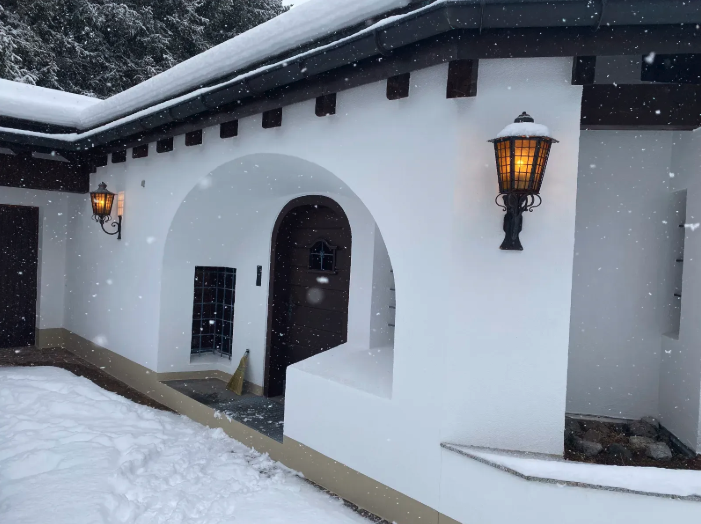
Exceptional chalet in Davos
A premium chalet ideal for executive retreats, private dinners, and team gatherings. Full privacy, stunning mountain setting, capacity for intimate corporate events.
Luxury Ski Chalet — Davos Dorf
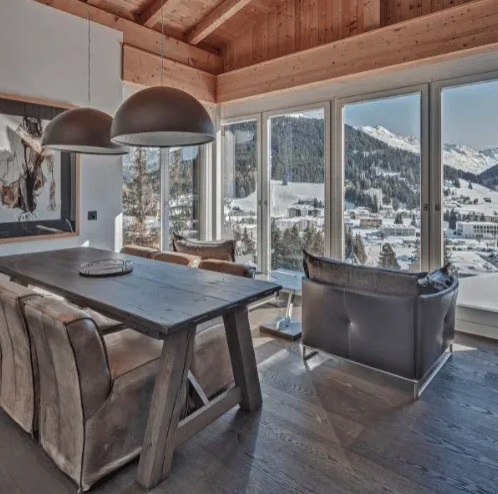
Luxury ski chalet Davos Dorf
A luxurious chalet with sauna, fitness area, and stunning views. Perfect as an operational base for leadership teams during WEF week, with space for private meetings and dinners.
Renovated Hotel Venue — Alpine Views
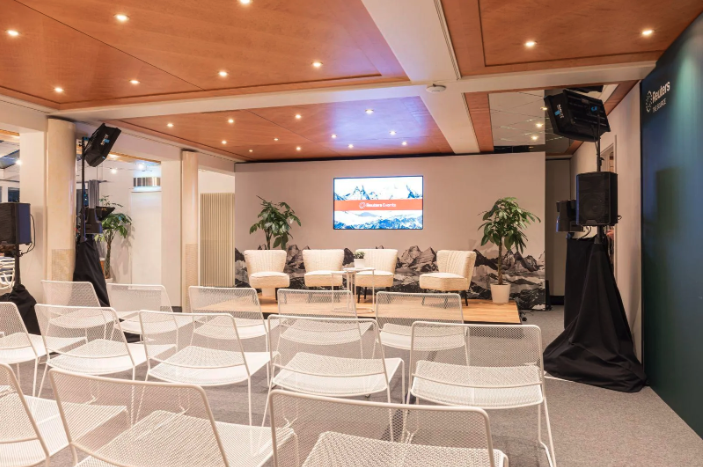
Renovated hotel venue Davos
A newly renovated hotel space in Davos with panoramic alpine views. Ideal for meetings, panels, and private hospitality — no building permit required.
10. How Native Spaces Can Support Your Davos Planning
We have been active in Davos since WEF 2024 and work closely with local property owners, accommodation providers, and service partners. The regulatory complexity of operating in Davos during WEF week is precisely where our experience adds most value.
Accommodation Sourcing — With the project cap reducing available event spaces and the one-project-per-user rule concentrating demand, premium accommodation becomes even more valuable. We source and manage luxury chalets, apartments, and private residences across Davos Platz and Davos Dorf — properties that can serve as quiet operational bases, executive meeting spaces, and private dining venues without triggering any permit requirements.
Venue Access and Strategy — Whether your Davos presence falls inside or outside the permit system, we help you understand your options, identify the right format, and connect you with the right spaces. For companies pursuing a permit-based activation, we can advise on venue selection and local partnerships. For companies seeking alternative formats — hotel-based events, chalet hospitality, private dining — we source and coordinate these directly.
Private Dining and Hospitality Programmes — For companies that prefer a curated, intimate approach to Davos — or that need a strong alternative to a full venue activation — we design and manage private dining programmes across Davos's best restaurants and private venues. No permit required, no cap, no competition for slots.
Local Knowledge and Regulatory Navigation — The WEF 2027 regulations are published in German and administered by the Gemeinde Davos. For international companies and agencies unfamiliar with the Swiss building permit process, the logistical requirements, and the local operating environment, working with a partner who understands the landscape is not optional — it is essential.
Get in touch: [email protected] · native-spaces.com
Browse our Davos venues: Chalets · Hotel Venues · All venues
Sources and Official References
- Gemeinde Davos — Official Announcement
- WEF 2026 Leitfaden (current reference, PDF)
- Reglement TP WEF (DRB 60.10)
- WEF Annual Meeting 2027 — Gemeinde event page
- Full WEF 2027 Guidelines (Leitfaden): Expected end of April 2026 at gemeindedavos.ch/wefdavos
Note: This briefing is based on the Merkblatt published by the Gemeinde Davos as of April 2026. Some details — including logistics fee increases and sustainability requirements — are still under review. We will update this document when the full guidelines are released.
Native Spaces · Unique spaces for high-stakes events
Cannes · Paris · Barcelona · Davos